The Linford & Company Blog is written by our very own auditors, who are experts in IT audits, information security, and compliance topics. Their auditing experience encompasses a broad spectrum of industries and organizations, and their specialized expertise can help your company or organization make the right decision for your auditing needs. Our specific areas of focus in our IT Audit & Compliance Blog include SOC 1 Audits, SOC 2 Audits, HIPAA Audits, HITRUST Certification, and FedRAMP Assessments, NIST & CMMC, and Penetration Testing.
If you’re an information security professional, there’s a good chance you’ve already heard about the MITRE ATT&CK framework. If it’s something you haven’t heard of, or if you haven’t found the time to dive into its vast trove of information, it’s never too late to start! The following are some of the most common questions […]
When considering controls for an organization, it may not be known that there are more than one level or type of control. To manage their business operations, organizations will have entity-level, divisional, regulatory, transaction-level, and process-specific controls to name a few. Of these controls, entity-level controls are considered to be a crucial part when: one […]
The description of a service organization’s system in a SOC 2 report is required to be prepared and assessed utilizing the description criteria guidance put forward by the American Institute of Certified Public Accountants (AICPA). The description criteria will be discussed in this blog to provide guidance on the factors to consider when describing a […]
The task of internal audit planning can be overwhelming and involve many individuals. Sometimes it is difficult to even know where to begin. In this article, we will break down a few of the common questions when it comes to an internal audit, elaborate on the key steps to the internal audit planning phase, and […]
“What are the responsibilities of management and the auditor in relation to internal control?” is a question we often hear from our clients and potential clients. We’ve talked a lot about what the auditor’s responsibilities are in an audit, but what about company management’s responsibilities in an audit? If you sign up for a SOC […]
When presented with the task of an audit being performed, the questions that the auditor and auditee have are: What is the objective of the audit? What is to be achieved? What is the need of the users of the output of the audit? Identifying Suitable Criteria Every audit is an evaluation of subject […]
The Oxford dictionary defines an assertion as “a confident and forceful statement of fact or belief.” Making an assertion is often used synonymously with stating an opinion or making a claim. While assertions are made in all aspects of life, most people think of a company’s financial statements or the financial statements audit when they think of assertions in an accounting or business setting.
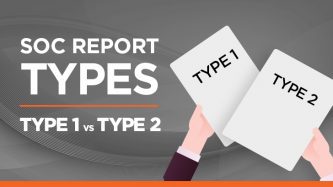
If you are being asked to obtain a System and Organization Controls (SOC) report by your existing user entity or a potential user entity, you may question whether you should obtain a SOC 1, SOC 2, or SOC 3 report. You may also wonder whether it should be a Type 1 or a Type 2 […]
Compliance with the requirements of the HIPAA Security Rule starts with understanding how it is constructed. The HIPAA Security Rule is part of the overall HIPAA Privacy and Security Rule and consists of standards and implementation specifications. Per HIPAA Security Safeguards: Each Security Rule standard is a requirement: a covered entity must comply with all […]
Manage Cookie Consent
We use cookies to optimize our website and our service.
Functional
Always active
The technical storage or access is strictly necessary for the legitimate purpose of enabling the use of a specific service explicitly requested by the subscriber or user, or for the sole purpose of carrying out the transmission of a communication over an electronic communications network.
Preferences
The technical storage or access is necessary for the legitimate purpose of storing preferences that are not requested by the subscriber or user.
Statistics
The technical storage or access that is used exclusively for statistical purposes.The technical storage or access that is used exclusively for anonymous statistical purposes. Without a subpoena, voluntary compliance on the part of your Internet Service Provider, or additional records from a third party, information stored or retrieved for this purpose alone cannot usually be used to identify you.
Marketing
The technical storage or access is required to create user profiles to send advertising, or to track the user on a website or across several websites for similar marketing purposes.