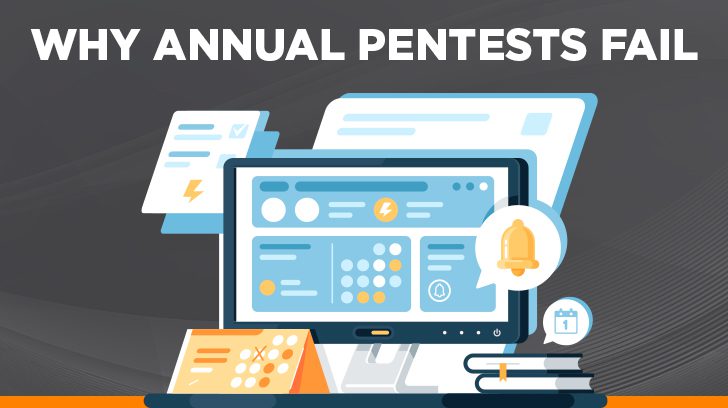
Most organizations rely on annual penetration testing to validate their security posture. On paper, that sounds reasonable, but in reality, it means your environment is meaningfully tested for maybe two weeks out of the year, and largely untested for the remaining 351 days
The bottom line: annual pentesting gives you two weeks of visibility and 351 days of assumption. That gap is where real risk lives.
How Pentesting is Supposed to Work & Why It Usually Doesn’t
In theory, a penetration test is meant to simulate an attacker: find weaknesses, validate exposure, and give you a clear picture of where you stand. In practice, it’s usually something else entirely.
In many environments, pentests are initiated to satisfy external requirements such as a SOC 2 control, a regulatory expectation, or a vendor security review. In those cases, the scope is often focused on what needs to be demonstrated for the audit, rather than on how an adversary would approach them. That distinction tends to influence how the engagement is defined and what gets tested.
From an auditor’s perspective, this isn’t an inherent flaw; it’s simply how the process is structured. But, over time, a pattern emerges: the difference between testing to satisfy a requirement and testing to simulate real-world threat actor behavior is often where some of the more interesting findings tend to exist.
The Moment Your Pentest Ends, the Clock Starts
One of the more uncomfortable truths about pentesting is how quickly it becomes outdated. Not because the test was flawed, or the testers missed something obvious, but because the environment itself doesn’t stay the same long enough for the results to remain relevant.
As auditors, we often see a new feature deployed; IAM role modifications to unblock workflows, the addition of new third-party integrations, and configuration changes that may quietly introduce vulnerabilities. None of these changes are unusual. In fact, they’re exactly what you’d expect in a modern environment. But none of them were part of the original test. So, even if your pentest was clean, or at least manageable, the environment it validated no longer exists in the same form.

The 351-Day Risk Window That Annual Pentesting Creates
This is where the idea of the “351-day risk window” comes from. If your pentest runs for about two weeks, that’s the only period during which your environment is actively evaluated from an adversarial perspective. After that, you enter a long stretch where your security posture is assumed, not tested.
At first, the drift is small. A few changes here and there. Then it compounds. By the time you’re a few months out, you’re operating in an environment that may be materially different from what was originally assessed. By month six or seven, you’re no longer relying on a current understanding of risk; you’re relying on historical data. And by the time the next annual test comes around, you’re effectively starting from scratch again.
What Even a Good Pentest Can’t See
It’s easy to assume that if a pentest didn’t find something, it probably isn’t there. That’s not how it works. Even strong, well-executed engagements operate within constraints. There’s always a tradeoff between coverage and depth. There’s always a scope boundary. There’s always a clock running in the background. Some of the more interesting issues we see, especially in complex web applications and API backends, often don’t show up immediately because they require time, interaction, and thorough testing to see how a system behaves under different conditions.
Things like workflow abuse, state manipulation, or changing seemingly minor issues into something more meaningful aren’t always obvious during a short engagement. Then, there’s everything that gets introduced after the test: new endpoints, new logic, new configurations, none of which have been looked at through the same lens. So, when people say “we passed the pentest,” what they really mean is, “nothing critical was found within a defined scope, during a limited time window, under specific conditions.” That’s a very different statement than, “we’re secure.”

Continuous Pentesting vs. Annual Pentesting: A Fundamentally Different Model
This is where continuous pentesting starts to make more sense; not as a buzzword, but as a different way of thinking about the problem. Instead of treating security validation as a discrete event, it becomes an ongoing process. Not just scanning, but actual testing that evolves alongside the environment. Something that can account for new features, new configurations, and new behaviors as they’re introduced. It’s less about producing a single report and more about maintaining a current understanding of risk. This distinction matters because the real issue isn’t that pentesting is flawed; it’s the way it’s commonly used when it assumes a level of stability that no longer exists.
| Category | Annual Penetration Testing | Continuous Pentesting |
| Testing Model | Point-in-time assessment conducted periodically | Ongoing assessment that evolves alongside the environment |
| Primary Driver | Compliance requirements and audit expectations | Operational visibility and risk awareness |
| Scope Behavior | Fixed scope defined at the start of the engagement | Adaptive scope that can incorporate new assets and changes |
| Visibility Into Risk | Snapshot of risk at a specific moment in time | Continuous insight into how risk changes over time |
| Handling of Changes | Changes after the test are not evaluated until the next cycle | Changes can be evaluated as they are introduced |
| Alignment with Real-World Threats | Simulates attacker behavior within a limited window | More closely reflects continuous attacker behavior |
| Risk Between Assessments | Risk accumulates between testing periods (the “risk window”) | Reduced gap between identification and validation of issues |
FAQs About Pentesting & Continuous Testing
Here are answers to some of the most common questions we hear about penetration testing and continuous testing approaches.
How Often Should Penetration Testing Be Done?
At a minimum, annually for compliance purposes. In practice, testing should align more closely with how often your environment changes.
What Are the Risks of Pentesting?
When performed correctly, the process is generally low-risk. The bigger issue is relying on it as a complete measure of security rather than a partial one.
Is Continuous Pentesting the Same as Automated Scanning?
No. Vulnerability scanning identifies known issues (often with misses or false positives). Continuous pentesting incorporates ongoing analysis, validation, and context that scanners alone don’t provide.
What Is the Future of Pentesting?
It’s moving toward models that reflect how environments actually behave: less periodic, more continuous, and more aligned with real-world attacker behavior.
The Gap Between ‘Tested’ & ‘Secure’
Annual penetration testing gives you a snapshot. The problem is everything that happens after the picture is taken. The remaining 351 days are when systems change, risk accumulates, and assumptions quietly drift away from reality. At some point, the question stops being whether you’ve been tested; it becomes how long you’ve been operating without being evaluated in a meaningful way.
If you’re thinking about the gap between annual pentesting vs. continuous pentesting approaches, it may be worth taking a closer look at how your current model aligns with how your environment actually changes. If you would like to discuss our approach to continuous penetration testing and learn more about closing your 351-day risk window, we would be happy to meet with you.