You have a beautifully written change management policy with every detail captured that acts as a guide to your engineering team; it is flawless on paper. It is time for your System and Organization Controls (SOC) 2 assessment, and the auditors found breakdowns in your change management controls. When the auditors pulled a random sample of production deployments, they found that 4 changes were developed, approved and deployed by the same person, a segregation of duties (SOD) finding. It was an immediate Type II SOC 2 exception.
In SOC 2 audits, change management is where written policies fall apart in practice. Commonly, organizations treat change management as an exercise in company culture and organizational transition; however, in this post, we will be focusing on IT and change management risks. Auditors treat change management as a control test to make sure that changes follow the controls that were designed to lessen the risk of unauthorized changes.
Under the SOC 2 framework, specifically Common Criteria (CC) 8.1 of the Trust Services Criteria, auditors are not auditing your written policy. Auditors are making sure that what you have written is being carried out and that you have controls in place that are operating effectively. If you need help understanding change management, explore our guide to change management. Below, we discuss what actually goes wrong in change management during audits, how these gaps lead to exceptions and what auditors test for.
Common Change Management Risks & Pitfalls
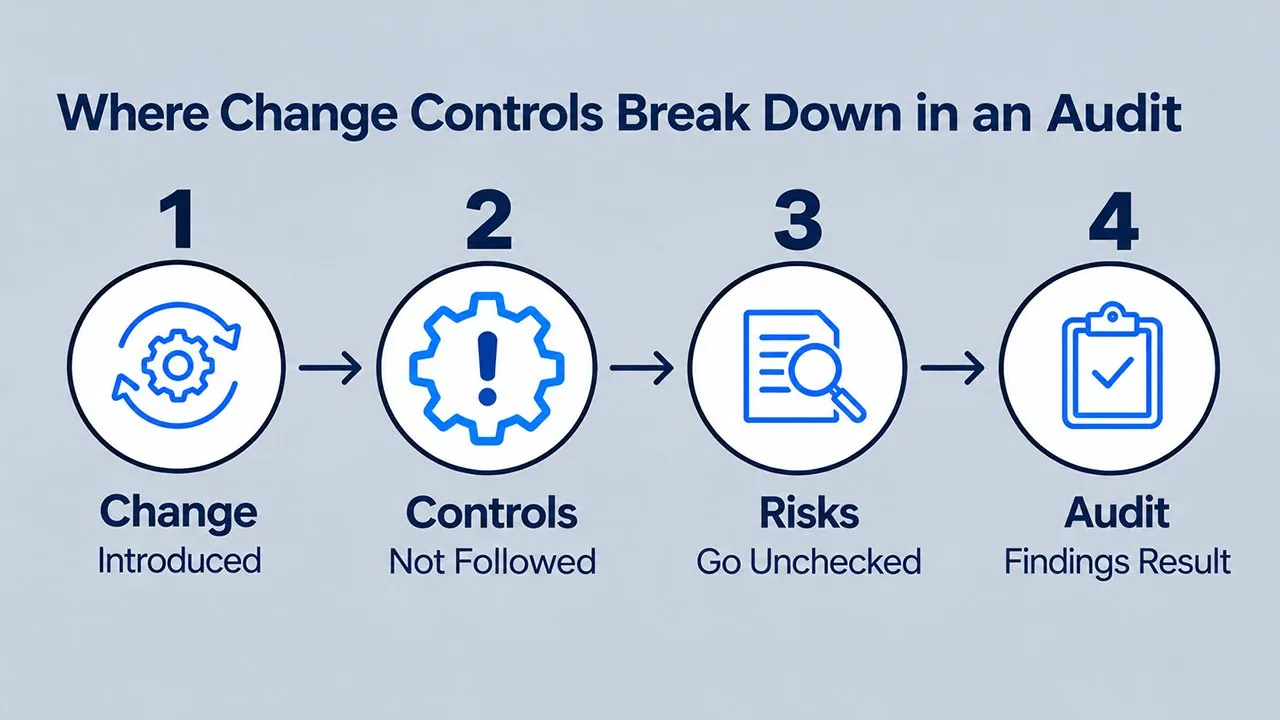
In my experience as an auditor, change management exceptions very rarely come from a poorly written policy or lack thereof. A majority of the organizations that I have audited maintain documented procedures outlining change management and the required approvals, testing criteria and segregated roles during the process. Gaps are usually identified during operational testing when we look at your controls in place and test that they are operating and that all approvals, testing and segregation of roles were followed.
1. Emergency Changes That Circumvent Controls
There are times when an emergency change is required and the steps of the approvals and testing need to be bypassed at the moment; however, those steps need to be retrospectively enforced. Those emergency changes still need to be approved and tested after the change has been implemented to make sure that the change is appropriate and documented as such.
What we see during audits, however, is that the emergency label occasionally turns into unmonitored changes. Recently, during a Type II SOC 2 audit, a change was pushed straight to production without controls being followed because it was an emergency change; however, the approvals and testing were never documented after the fact. When the testing for the audit took place, there wasn’t any documented evidence that the controls were followed, including documented explanations of why the controls were circumvented. Without the documented evidence of testing and approvals, a gap was identified for this sample, and an exception was documented.
2. Failed Segregation of Duties
A very common breakdown that we see in change management is the muddling of development and deployment roles/privileges. Branch protection rules may require a second reviewer or an approver by default; however, administrators can often bypass those rules. Because of this breakdown, we see administrators who review and approve their own changes, or directly merge code into production repositories without an independent party. From an audit standpoint, this leaves a breakdown of segregation of duties, and again, an exception is documented in the audit report because there is no independent reviewer/approver.
3. Missing or Insufficient Testing Evidence
A “tested fine locally” documented in a change ticket does not meet the requirements as auditable evidence. Depending on what your control requires, we look for evidence such as functional test suites run (both positive and negative), integration checks passed and user acceptance testing (UAT) took place, all in a staging/testing environment, separate from development and production. When these details are missing from the ticket, it is hard for an auditor to say that testing was performed and passed, which then leads to an exception.
4. Changes That Are Not Documented in Tickets
There are occasionally changes that bypass the ticket systems used in change management. Examples include manual console adjustments, infrastructure drift and unscheduled administrative adjustments. An administrator might tweak a security group rule directly within the management console. This type of change will leave no documented workflow, which in turn leaves no audit trail with approvals and other required evidence, which then leads to an exception.
Change Management Risks & Controls at a Glance
This table maps each of the 4 risks above to what we see in practice and the evidence we look for when testing CC8.1.
| Risk | What We See in Practice | What Auditors Look For (CC8.1) |
|---|---|---|
| Emergency changes that bypass controls | The emergency label is used and approval and testing never follow | After-the-fact approval and testing, plus a documented reason controls were bypassed |
| Failed segregation of duties | Administrators approve or merge their own changes | An independent reviewer or approver recorded for each change |
| Missing testing evidence | Tickets say “tested fine locally” with no results | Test results from a separate staging or testing environment attached to the ticket |
| Changes outside tickets | Console adjustments and infrastructure drift with no ticket | A ticket with approvals for each production change in the sample |
What Do Auditors Test in Change Management?
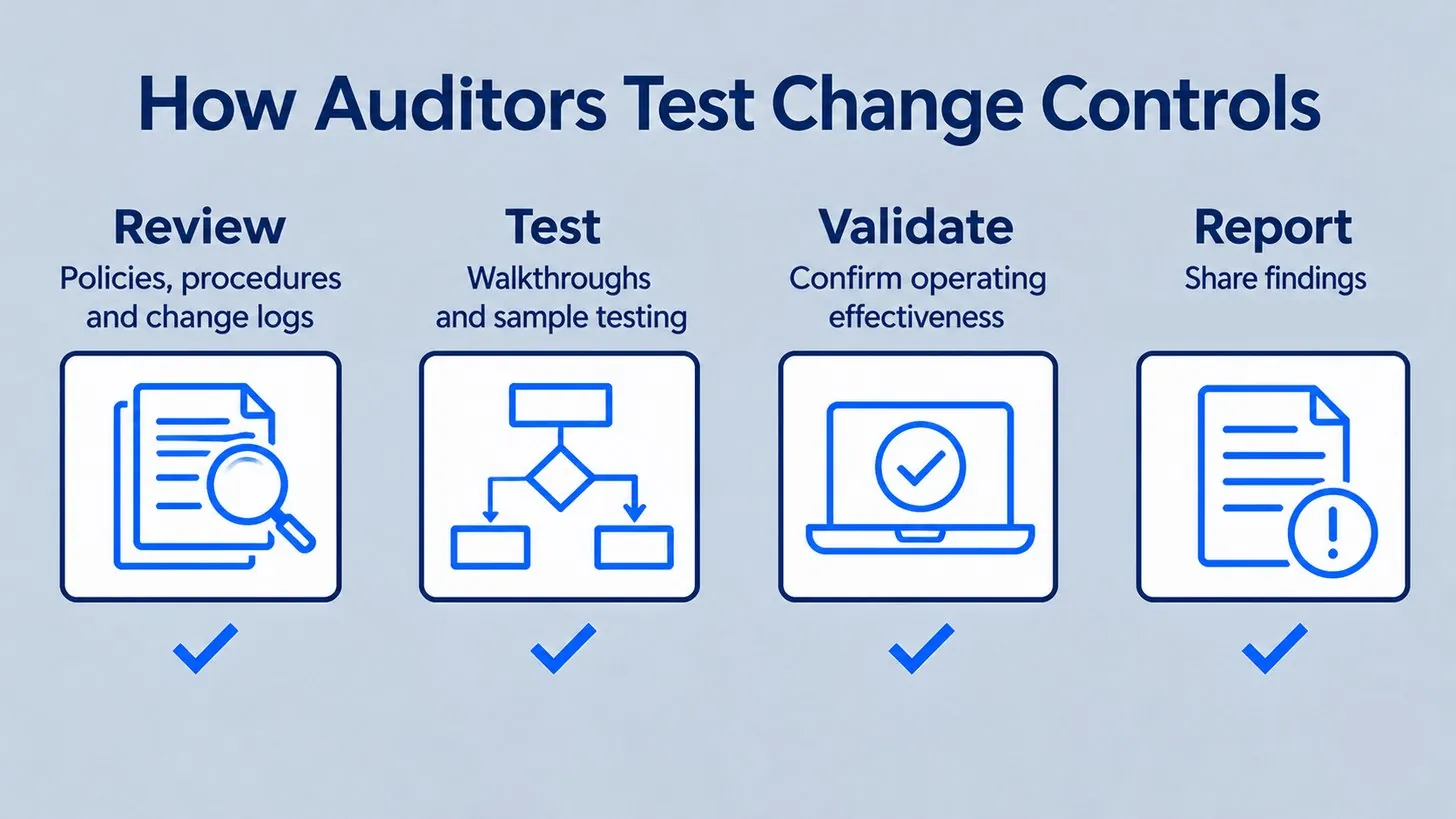
Auditors test the following when evaluating change management controls:
- Emergency change control documentation: During testing, auditors are looking for retrospective testing and approvals of the emergency changes. We know there are instances where changes need to be implemented quickly to fix an issue; however, those changes still need the proper testing and approvals.
- Automated workflow controls: Auditors are looking to see that your branch settings are configured to block self-approved merges, administrator override of branch protection rules is disabled and passing test checks are required before any change can deploy.
- Ticket log reconciliations against production releases: Auditors look to see that management matched the production deployments against ticketing records to make sure that all changes have a ticket with sufficient documented evidence on a periodic basis.
- Administrative privilege restrictions: Auditors test that the company has limited who has direct write/update permissions in production and that all configuration adjustments went through version-controlled workflows.
Change Management Risk FAQs
These are the questions we hear most often about change management risks in a SOC 2 audit.
What Are the Most Common Change Management Failures Auditors Identify?
The most frequent audit failures include lack of segregation of duties (developers approving their own pull requests), insufficient test documentation, untimely approvals and non-ticketed changes.
Why Does Change Management Fail in an Organization?
Change management typically breaks down when controls are circumvented, either through manual shortcuts or gaps in automated workflows. Missing or incomplete documentation is what we see most often behind change management failures. Most organizations do not mean harm but just forget to document the process, especially in emergency change situations.
What Is the Difference Between a Type I & Type II Change Control Exception?
During a SOC 2 Type I audit, controls are evaluated at a single point in time to determine whether controls are designed and implemented appropriately. In a Type II audit, controls are evaluated across a period of time, typically 6 to 12 months (see the differences between Type I and Type II SOC reports). For example, during a Type I audit, we would obtain the latest ticket for a change and evaluate the controls around that change. In a Type II audit, we would obtain a sample of changes during the period (based on the population) and evaluate the controls around the sample of changes.
Summary
Surviving an audit in regard to change management ultimately comes down to making sure the controls in your policies are in place. We don’t just audit the written policy; we evaluate whether your controls are designed, implemented and operating effectively through your documentation.
To learn what we test in a SOC 2 examination, get in touch with our team at Linford & Company LLP. As an independent audit firm, our team of IT and audit professionals conducts SOC 1 and SOC 2 examinations.
Related services
SOC 2 Audits
Independent SOC 2 examinations covering security, availability, confidentiality, processing integrity and privacy.
Related articles
SOC 2
The COSO Principles & SOC 2: What the Framework Requires & What Auditors Actually See
Becky McCarty · October 28, 2026
SOC 2
What Is SOC 2 Compliance? Requirements, Reports & Audits Explained by a Veteran IT Auditor
Rob Pierce · October 14, 2026
SOC 2
SOC 2 Physical Security in a Remote-First World: What Auditors Actually Look For
Jessica Kiel · June 3, 2026