If you are reading this post, chances are you’ve recently learned that your company needs a SOC 2 report (or a SOC 1 report). Your first thought was probably, “What is a SOC 2?” Which was quickly followed by “How much is this going to cost?” This is a perfectly normal and reasonable question to ask. However, you need to understand that, without additional information, the answer is, “It depends.”
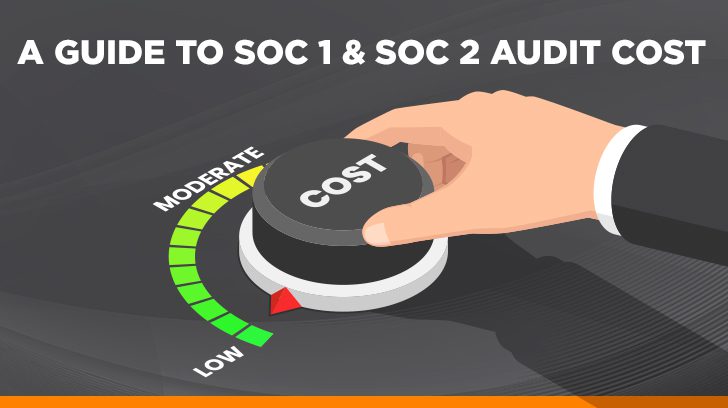
SOC audit costs typically range from $20,000 to $150,000, with a median price around $30,000. If you are working with a big 4 accounting firm, you can expect SOC audit fees to start in the low six figures and go into the millions of dollars.
Why Isn’t There A Standard Price For a SOC 2?
So, how much does a soc audit typically cost? It is important to understand that the SOC cost breakdown is driven by the effort required to perform the necessary tasks to assess whether an organization meets certain requirements. SOC 2 audit costs are based on assessing whether an organization meets the applicable Trust Services Criteria. Similarly, SOC 1 audit costs are based on the effort required to perform the necessary tasks to assess whether an organization meets the specified control objectives.
While some may tell you otherwise, there simply isn’t a standard, one-size-fits-all SOC 2 audit. We issue hundreds of SOC 2 reports a year, and each one is unique because our test procedures for each audit are customized to the client’s distinct organizational structure, system(s), services, and technological environment. Some reports are just 50 pages long, while others are two to five times larger.
Be wary of any audit firm offering a quote without asking questions about your organization and technology environment. It would be like a car salesperson giving you a firm price on a new vehicle without knowing what car you want. How confident would you be in that quote? Unless they’re telepathic, they don’t know if you want a base-model sedan, a heavy-duty truck, or a sports car.
Just as a salesperson can’t provide the price for a car without knowing the make, model, and trim, an audit firm cannot provide an accurate quote for a SOC 2 engagement without knowing a number of factors that drive the level of effort required to perform it.
What Factors Impact the Cost of a SOC 1 or SOC 2 Audit?
There are a number of factors affecting SOC 2 audit cost that need to be understood by an audit firm to determine the amount of effort to perform the examination and, therefore, your costs for a SOC audit. These include the:
- Scope of the Assessment
- Type of Assessment
- Nature of the Organization’s Services
- Composition of the Organization
- Number of Locations
- Extent and Relationship with Subservice Providers
A firm must understand all of these components to provide an accurate and reliable quote. If you get a blind quote (no questions asked), chances are the fees will increase as the audit is performed when “new facts” are uncovered, or there will be a significant jump in price the following year. This bait and switch typically occurs far enough along in the process that it will be too costly, too difficult, or too late to switch audit firms.
Scope of the Assessment
What or how much is to be covered in an examination will impact the price of the SOC audit.
Number & Nature of Control Objectives in Scope (SOC 1)
The effort to perform a SOC 1 audit can vary a great deal based on the number and nature of control objectives included in the scope. Your organization, as the service organization, specifies the control objectives and controls to be tested based on their impact on your clients’ internal control over financial reporting.
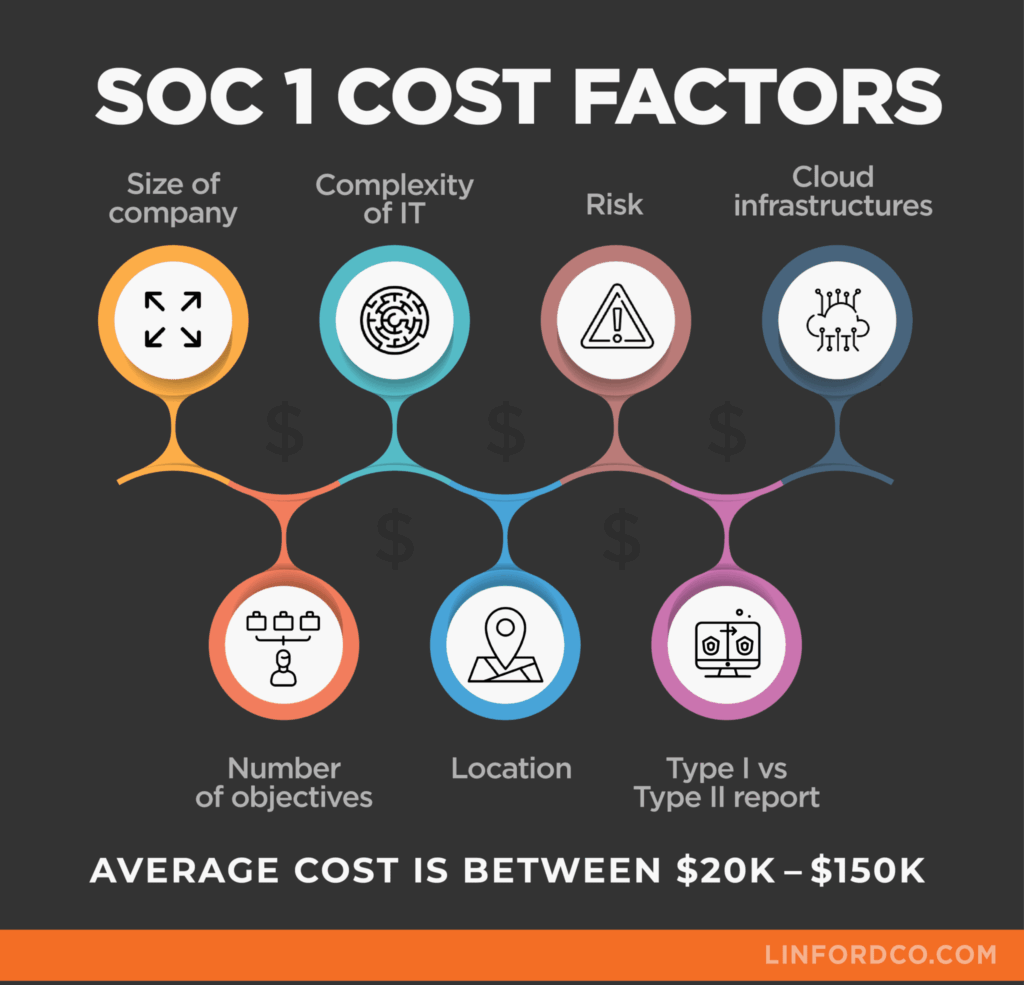
For example, if you were getting a SOC 1 report and for a co-location of a data center with no managed services, you may only need four or five control objectives. However, a payroll processor’s SOC 1 report may have more than a dozen control objectives to address the potential impacts that it may have on its clients’ financial reporting. Typically, the amount of effort and price rises as the number of control objectives increases.
Number of Trust Services Criteria in Scope (SOC 2)
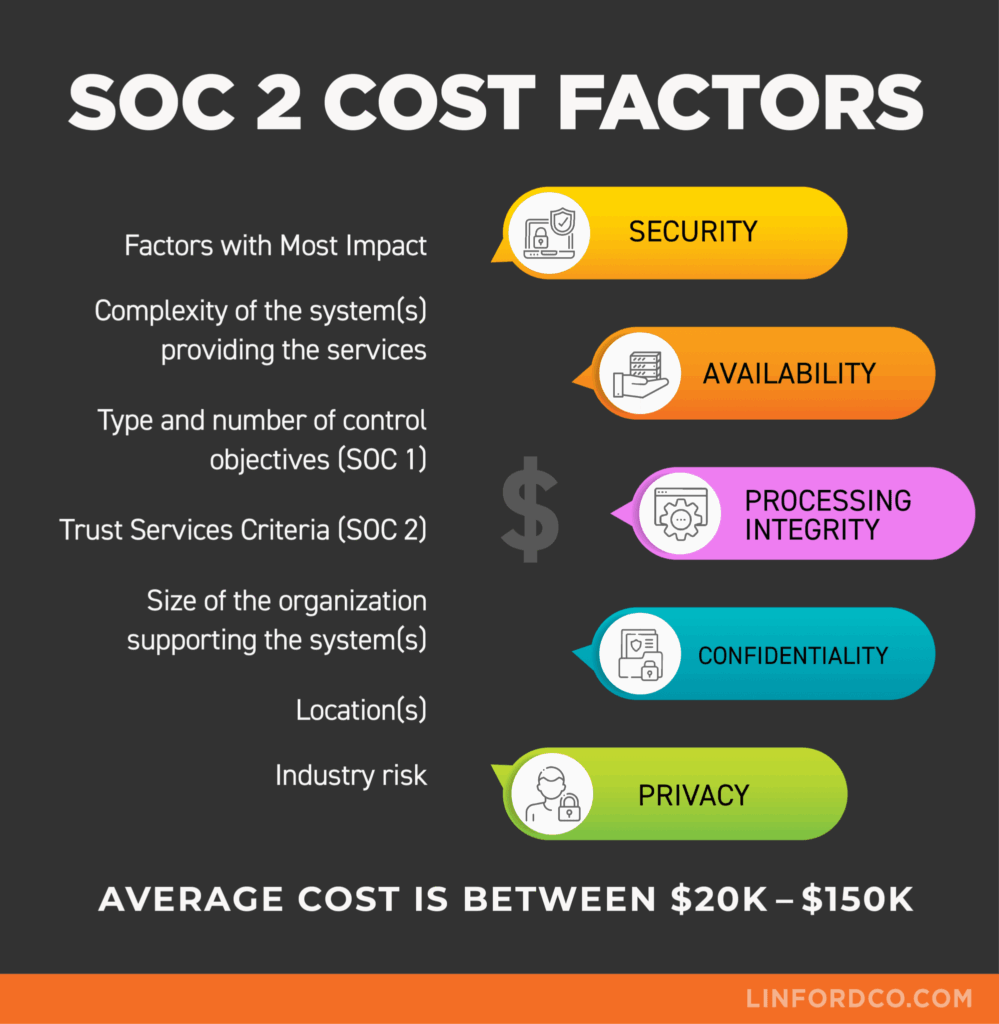
How much does a SOC 2 audit cost? That will depend on how many of the five Trust Services Criteria are included in the scope of a SOC 2 audit. They are the following:
The Security criteria is the Common Criteria that must be included in every SOC 2 audit. The remaining four criteria are optional. We counsel our clients to include only the Security criteria unless a client specifically requires them to include other areas. The Availability, Processing Integrity, and Confidentiality criteria usually result in smaller incremental increases to the cost of the SOC 2 examination. Adding Privacy is an expensive add-on.
Number of Systems in Scope
Each additional system within scope multiplies the effort required to complete the SOC audit. Don’t panic if you have more than one application or platform that needs to be assessed. While adding a system to the scope will increase the amount of effort and the audit fees, the audit fees should not double, as only a portion of the criteria are specific to technologies.
Readiness Assessments
Some firms price readiness assessments separately from audits, while others will lump them together. You will want both because the last thing you want is to complete your first SOC audit only to find out that you failed. If you are comparing quotes, be sure to ask firms to provide you with the price for performing a readiness assessment and the subsequent SOC audit. This will allow you to figuratively compare apples to apples.
Type of Assessment
Be sure to have the right type of SOC audit. There are two types of assessments: type I and type II (also commonly referred to as type 1 and type 2). I know, we auditors are really creative in our naming conventions (SOC 1, SOC 2, type 1, and type 2). We have a wonderful post that shares the details of the differences between type 1 and type 2 assessments. In regard to cost, the cost of a Type II audit will typically be more expensive than a Type I.
Nature of the Organization’s Services
Some industries and businesses are inherently riskier than others just by their nature. Increased risk requires a higher level of scrutiny and additional procedures to assure that the service auditor is adequately addressing the related risks. Services that entail complex processes, specialized technology, involve multiple systems, or require validation of detailed calculations require additional effort. For example, a scheduling service is less risky than a loan or tax processing. Similarly, an assessment of a service that runs on a single application is less complex to assess than multiple systems that reside in different IT environments that are supported by siloed personnel who follow different processes.
Composition of the Organization
The size of an organization is one metric used to gauge effort, as it can reflect an organization’s complexity. As you might guess, performing a SOC audit for a small start-up typically requires less effort than doing one for a Fortune 500 company. At a small start-up, auditors interview fewer people to understand the systems, processes, and controls in the scope of the audit. Similarly, smaller organizations are often more responsive to audit requests.
The maturity of an organization’s control environment also impacts how much effort is required to assess it. If the control framework is not formally documented or hasn’t ever been assessed, it will take more effort by auditors to identify the controls within the processes supporting the systems and services. The maturity of the environment will also drive your organization’s ability to obtain a Type I or Type II SOC report initially. If controls are not in place or have not been operating for a period of time to meet control objectives (SOC 1) of the Trust Services Criteria (SOC 2), you will need to address the gaps internally and operate the controls for the desired period in order to get a type II report.
Number of Locations
The effort and cost of a SOC audit go up as the number of locations increases. If controls relevant to the in-scope systems and services are performed at multiple locations, service auditors will need to assess the controls at each location. If processes are the same at each location, auditors can perform procedures to validate them and combine populations from the various locations into a single population for testing for a control. However, if controls or processes vary between locations, auditors would need to perform testing separately for each location. Just think about all the data centers that are covered by AWS, Azure, or GCP’s SOC reports.
Extent and Relationship with Subservice Providers
Most service organizations use vendors to perform or support a part of the services they provide. A subservice provider is a vendor that helps the primary service organization meet its service commitments or system requirements and is responsible for performing certain controls as a part of its services. For example, an organization that hosts its SaaS application in AWS relies on AWS to perform controls to maintain the physical security surrounding its facilities.
Why Is SOC 2 So Expensive?
Every accounting firm must make money. So, each firm’s price will have three components:
- Estimated Cost of Labor: The earlier sections of this post focus on the components of estimating the cost of labor.
- Overhead Expense: Overhead is comprised of expenses a firm incurs that are not directly related to client services.
- Profit: Earnings to be made in excess of the total cost.
One would think that labor would be the largest component of the price, and it should be. So, how much a firm pays its personnel does significantly impact the fees they must charge. Unfortunately, for a lot of larger firms, overhead expense is the greatest expense or a very close second. This is to account for the firm’s expenses related to marketing, office buildings, sponsorships, and (perhaps the biggest of them all) pensions for the tens of thousands of retired/former employees. Of course, audit firms need to make some profit to stay in business. At Linford & Company, we have a modest office and keep expenses to a bare minimum so that we can charge clients reasonable fees.

What Else Impacts the Price of SOC Audits?
We have addressed the fees an organization pays an audit firm to perform the SOC audit. However, these are not the only costs organizations incur related to SOC compliance. Internal costs will often exceed audit fees. These internal costs may include the following:
- Time spent documenting policy and procedures
- Time spent identifying and mapping controls to requirements/criteria
- Time spent testing and monitoring internal controls
- Tools used to support internal control monitoring
- Time spent fixing issues that were identified
The use of compliance automation tools continues to become more common. These tools can be very helpful to an organization that is designing its internal control framework to comply with the requirements or criteria of a variety of standards. If properly set up and integrated with an organization’s processes and technology environment, they can also provide management with timely monitoring of their environment. Please refer to this post on FAQs about SOC 2 Automation Tools.
How much does SOC monitoring cost? That will depend on the tool(s) used and the extent to which they are incorporated. These tools can help reduce audit fees. A 10% or 20% fee reduction would be good. However, be careful if the vendor providing your compliance tool has a “partner” audit firm(s) with a set audit fee that is extremely low compared to other bids in the market. There are recent cases where those too good to be true prices turned out to be just that. In one case, the auditors were simply providing the same form report to all their clients, with essentially only the names and product names being changed.
Navigating SOC Audit Costs with Confidence
We have briefly discussed how to determine the total cost of obtaining a SOC audit and some of an audit firm’s key considerations when pricing a SOC engagement. Linford & Company is a CPA firm that specializes in SOC 1 and SOC 2 assessments. We welcome the opportunity to discuss each unique service organization’s audit needs in person or over the telephone. After an engagement scoping discussion, we will deliver a brief audit proposal with firm pricing within a few business days. We price all of our SOC 1 and SOC 2 examinations on a fixed fee basis for professional fees.
Please also note that although our fees are significantly less than those of the “Big Four” accounting firms, they are not always less than those of other firms. This is due to the experience, background, and certifications of our audit professionals and the level of partner involvement on each engagement.
See the following blogs for more related information on SOC reports and controls:
- SOC Audit Report Overview: The Definitive Guide
- Who Can Perform a SOC Audit?
- How Long Does a SOC Examination Take?
This article was originally published on 6/13/2018 and was updated on 2/4/2026.