Compliance
What the AICPA's Own Diagrams Say About Private Equity in Audit Firms
The AICPA's proposal on alternative practice structures adds rules for PE-backed CPA firms. Its own diagrams show why the structure is the problem.
In Serving Two Masters, my partner Richard Rieben explained how private equity firms use the alternative practice structure (APS) to buy into CPA firms and why that puts the public trust at risk. I want to add to his argument. I read the AICPA's own materials on the proposal: the exposure draft its Professional Ethics Executive Committee (PEEC) issued in December 2025 and the webinar presentation PEEC used to walk members through it in March 2026.
First, what the proposal is and isn't. It does not loosen independence rules. It adds requirements for firms that already operate in an APS, which state laws allow. I don't question the work or the good faith of the people who wrote it. My point is simpler: when the rules have to be this complicated, the structure is the problem.
Start With the Code's Own Test
The AICPA Code of Professional Conduct requires a member who performs audits and other attest services to be independent in fact and in appearance. Independence in appearance is judged by a reasonable and informed third party: someone who knows the relevant facts and asks whether the auditor's objectivity could be compromised. The March 2026 presentation restates this standard near the start and says the proposed interpretation is built on it.
That is the right test. So let's apply it to the structures the AICPA itself describes.
One Box or More Than a Dozen
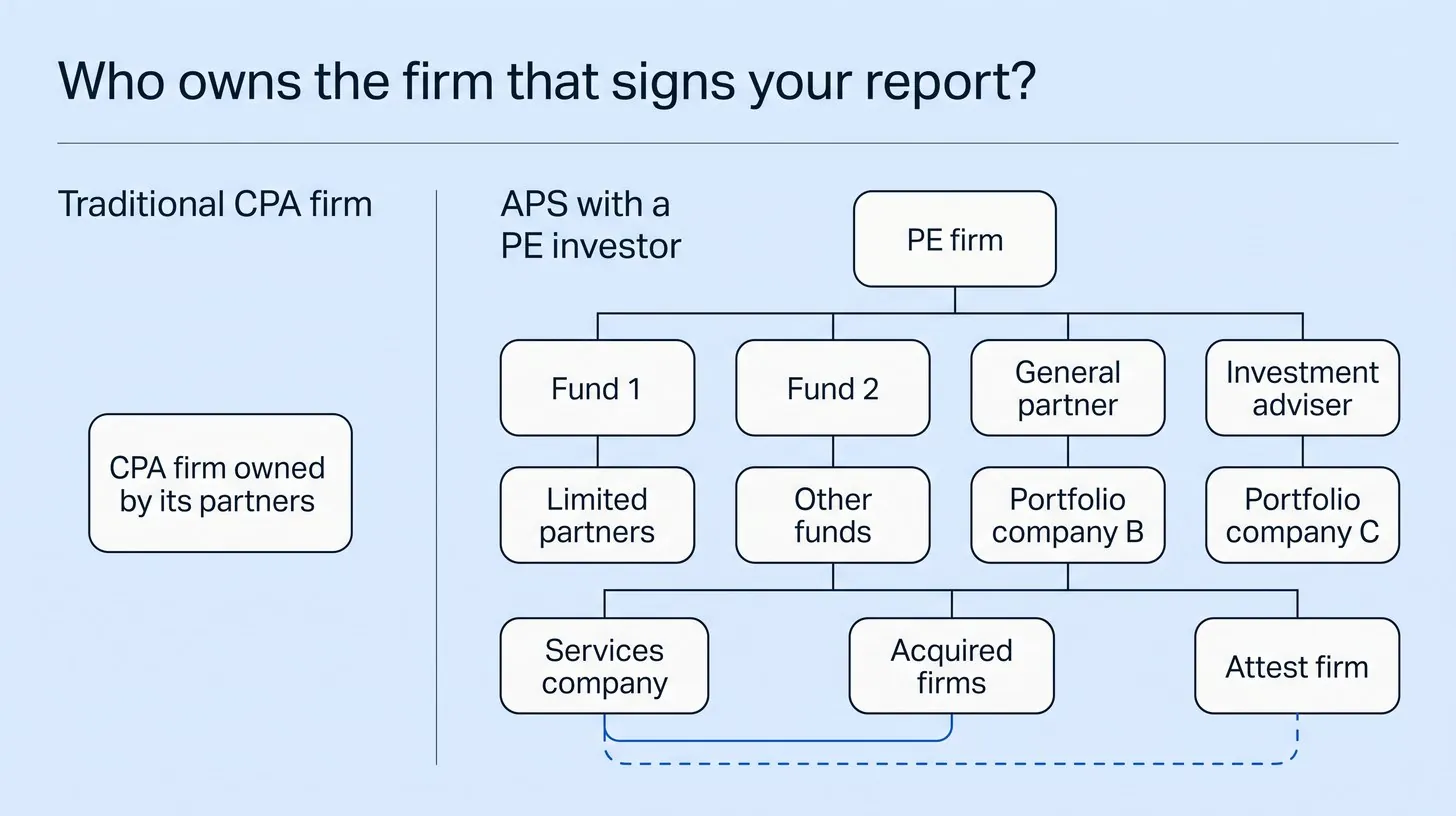
In a traditional CPA firm, the answer to "who owns the firm that signs the report?" fits in one box. The CPA partners own the firm, and the firm issues the report.
In an APS, the presentation needs a full slide diagram to answer the same question. The firm is split in two. The attest firm, majority owned by CPAs, signs the reports. A separate nonattest entity, owned at least in part by investors, employs the people and provides the offices, technology and other services under an administrative services agreement. The presentation shows three versions of this model: one with a public or private investor, one with a private equity investor and one with a public company investor.
The private equity examples near the end of the presentation map more than a dozen entities around a single attest firm: the PE firm, its funds, each fund's general partner and investment adviser, the fund's limited partners, other funds, other portfolio companies and their subsidiaries. Each entity is color coded by which independence rule applies to it. Some must always comply with the independence rule. Some cannot be attest clients. Some must be evaluated case by case using the conceptual framework.
The Ownership Chain
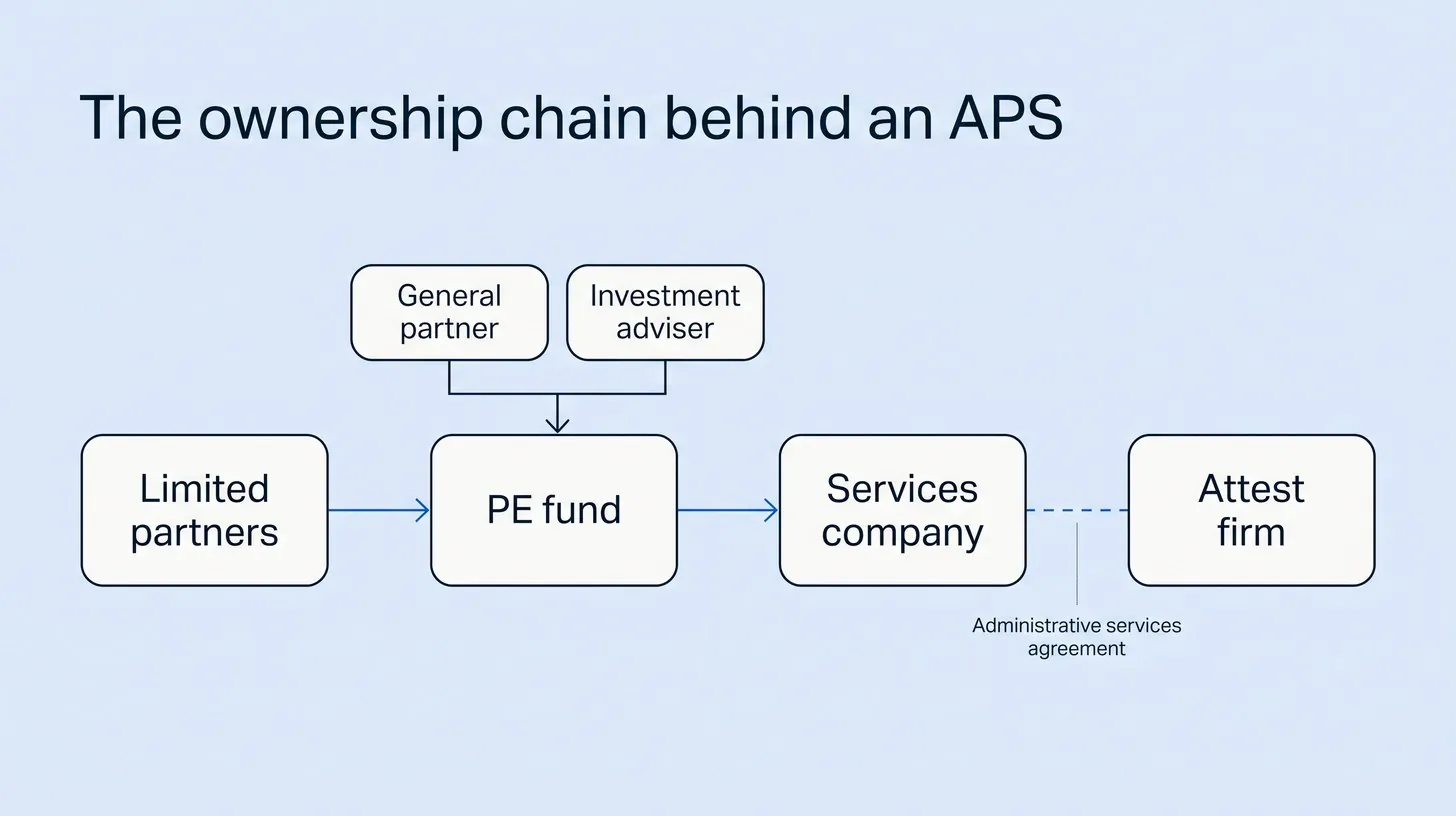
Follow the money in the private equity version. Limited partners invest in a fund. The fund is run by a general partner and an investment adviser. The fund owns some or all of the nonattest entity. The nonattest entity provides nearly everything the attest firm needs to operate, and the attest firm compensates it for those services.
The exposure draft addresses this chain by defining which entities are part of the attest firm's network and which relationships impair independence. Under paragraph .18, for example, an attest firm cannot perform attest services for the investor, the fund or the fund's general partner or investment adviser. Those rules are necessary. They are also an acknowledgment that the people at the top of the chain have interests an auditor must be protected from.
Who Counts as a Covered Member
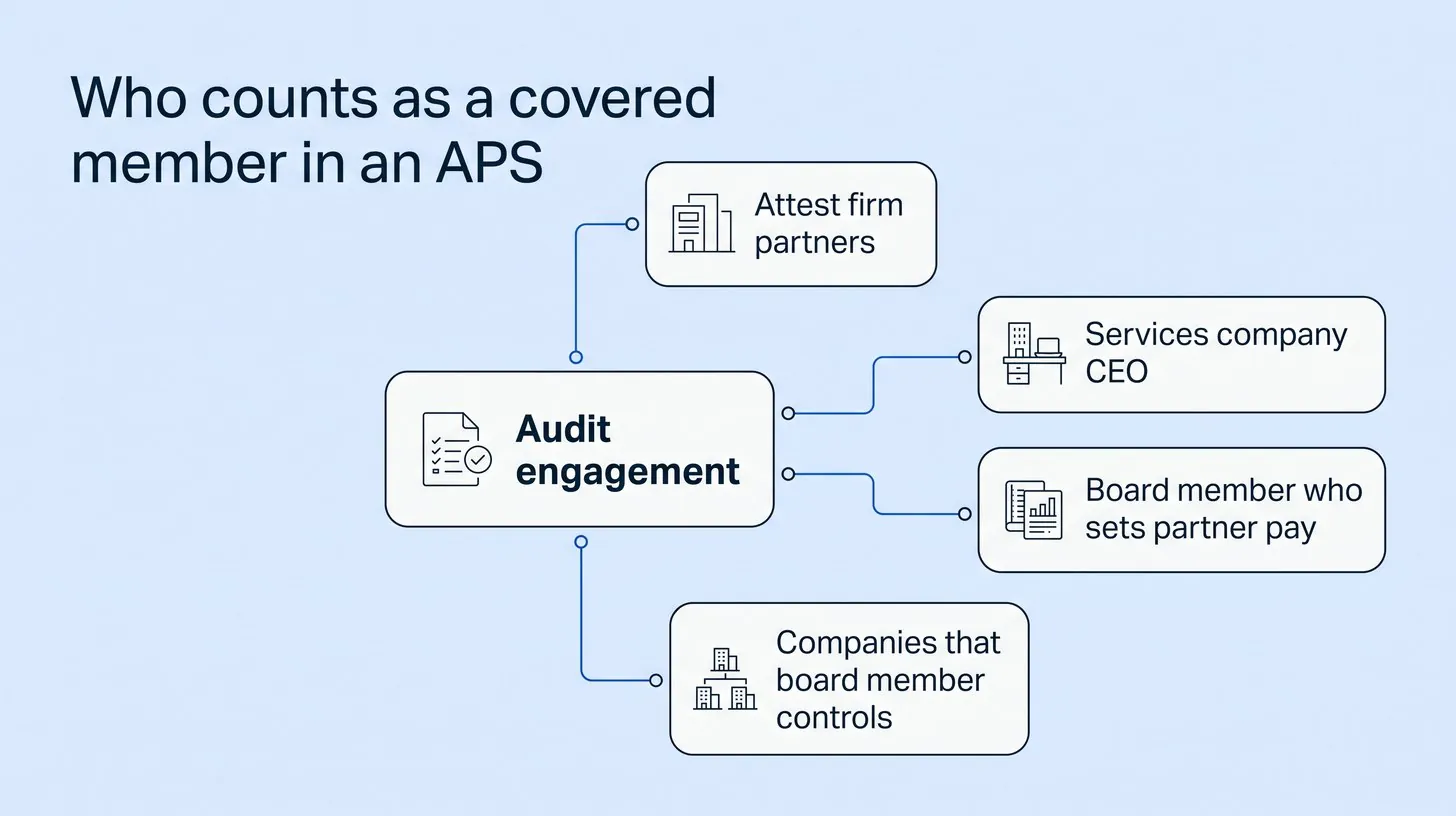
A covered member is someone who must personally be independent of an audit client because they can influence the engagement. In a traditional firm, that means the engagement team and the partners and managers above them.
The presentation's examples show how far that reaches in an APS:
- A board member of the nonattest entity who recommends or approves individual audit partners' compensation is a covered member.
- When audit partners are employees of the nonattest entity, the nonattest entity's chief executive who signs their performance appraisals is a covered member.
- When a PE principal who is a covered member controls other portfolio companies, those companies become covered members too.
Each example is a sensible rule. Taken together, they describe audit partners whose pay and performance reviews can be decided by people who work for, or answer to, an investor. The reasonable and informed third party would want to know that.
The Threat the AICPA Names
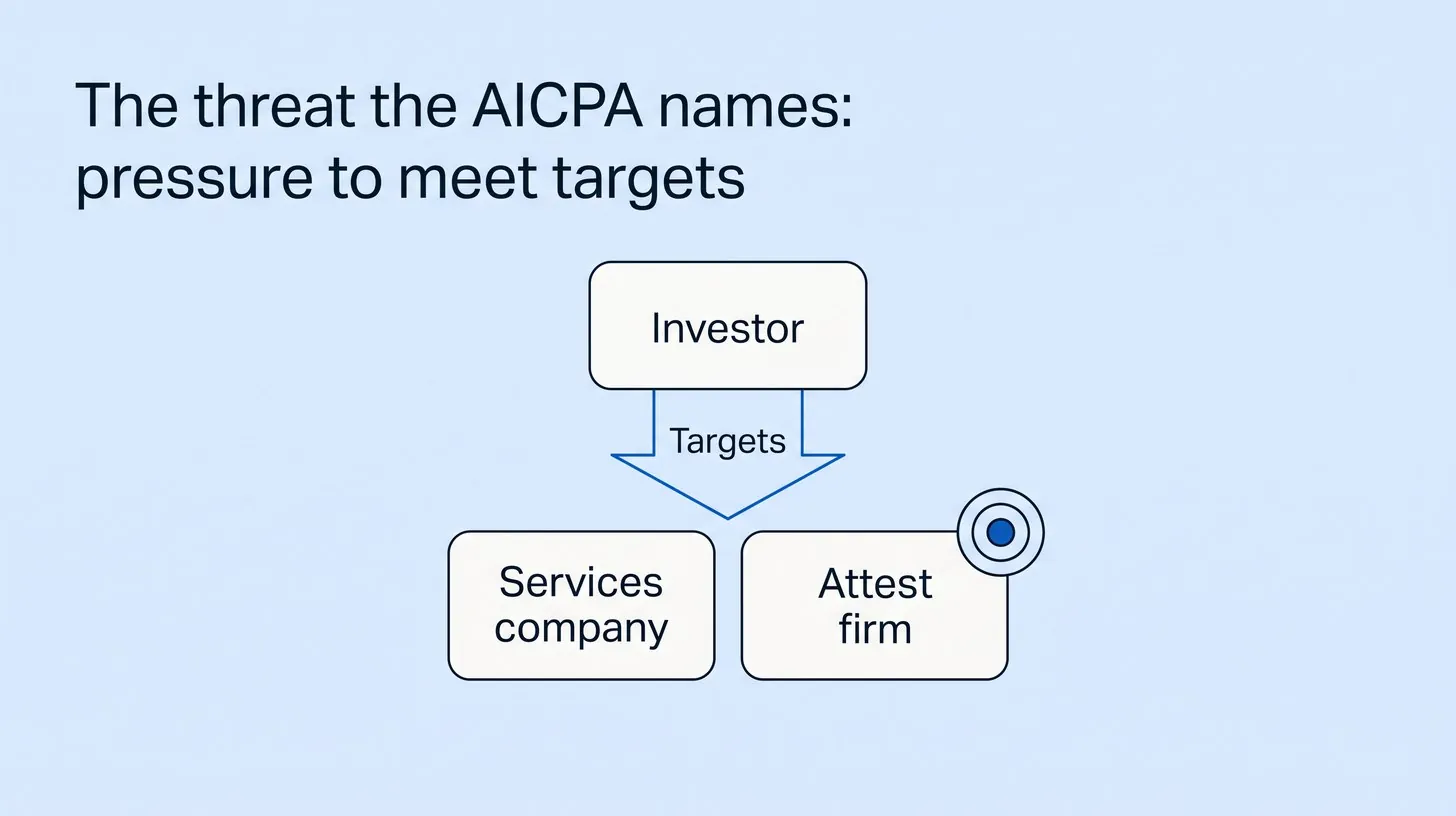
The proposal also adds new examples of an undue influence threat to the Code's conceptual framework. One is an individual acting for the investor who takes part in decisions on the attest firm's independence, quality management or partner compensation. Another is an investor that "pressures the attest firm and/or nonattest entity to meet internal or external targets."
Naming the threat is the right thing to do. But private equity funds are built to meet targets. A fund raises money from limited partners, invests it for a set period and is judged on the return it delivers at exit. A rule can identify that pressure as a threat to independence. It cannot remove the reason the pressure exists.
What Is Still Unsettled
The materials also show how much remains open:
- Disclosure to clients. The proposal would require the firm to tell clients which services the attest firm provides and which the nonattest entity provides. That rule exists because a client would not otherwise know.
- Commissions and contingent fees. The presentation says the task force is still considering how those rules apply to the nonattest entity.
- Whether it works. Among the questions for commenters, PEEC asks whether the proposed guidance is operational.
- Network firms. In one of the presentation's examples, a PE firm that owns 60% of the nonattest entity and advises on budget and strategy for the attest firm was not treated as a network firm. To PEEC's credit, the revised proposal it approved in November 2026 treats a controlling investor as a network firm automatically.
PEEC received 81 comment letters on the first draft and has approved a revised exposure draft (opens in a new tab) that will be open for comment for 120 days once it is posted.
Questions to Ask Your Auditor
If you are choosing an auditor, the ownership structure behind the report is worth understanding. A few direct questions will tell you a lot:
- Who owns your firm? Does any outside investor own part of it, or part of a company it works with?
- Are your audit partners employed by the firm that signs the report or by another company?
- Does anyone outside the attest firm have a say in your partners' compensation or performance reviews?
- Which entity will perform each service we receive?
Summary
The AICPA's materials on alternative practice structures are thorough, and the revised proposal tightens several rules. But the diagrams tell the story on their own. A traditional CPA firm fits in one box. An APS with a private equity investor needs more than a dozen boxes, a color code and a three-step process to decide who must be independent of whom.
Anyone can comment on the revised exposure draft once it is posted on the AICPA's website (opens in a new tab), and I encourage CPAs, audit committees and report users to do so.
Firms like ours get these offers too. Almost every day a broker or a private equity backed company asks me whether we would consider selling Linford & Company LLP. My answer is always short: we are not taking outside investment, now or in the foreseeable future. Linford & Company LLP is owned by its partners and has no outside investors. If you have questions about independence or how your auditor is structured, contact us.
Related services
SOC 2 Audits
Independent SOC 2 examinations covering security, availability, confidentiality, processing integrity and privacy.
All Services
SOC, HIPAA, HITRUST, FedRAMP, ISO, PCI DSS, CMMC and penetration testing from one independent firm.
Related articles
Compliance
How to Choose the Right VPN: What Auditors Look for in a Compliant Remote Access Environment
Megan Kovash · November 4, 2026
Compliance
Information Security Risk Management: What the Frameworks Say & What Auditors Actually See
John Pohlmann · October 7, 2026
Compliance
Creating a Culture of Compliance: What It Really Looks Like & How to Build It
Tim Nackos · September 16, 2026