Imagine your mid-sized firm has just received an exhaustive 200-question security audit from its largest enterprise client, coupled with a Board of Directors suddenly demanding a formal policy on “AI Safety.” Without a dedicated security leader, these high-stakes requests often land on the desk of an already overstretched IT Director, leaving your organization reactive, vulnerable, and potentially uninsurable.
According to ISACA’s State of Cybersecurity 2025/2026, while 70% of organizations now have a designated Chief Information Security Officer (CISO), the role has become increasingly unsustainable for the mid-market. As of early 2026, the average total compensation for a full-time CISO in the United States has climbed to a range of $350,000 to $600,000, leaving a massive “expertise gap” for small and mid-sized enterprises. Furthermore, with nearly 53% of organizations reporting that their security budgets are underfunded and 2026 regulatory fines for data breaches hitting record highs of $10.22 million on average in the U.S., hiring a full-time executive can feel less like a luxury and more like a financial impossibility.
So, how does an organization navigate a landscape of AI-powered phishing and strict new personal liability for board members without a massive payroll expansion? How do you validate you have the strategic leadership to govern autonomous AI agents and satisfy rigorous 2026 audit requirements on a limited budget? The solution for many is the virtual CISO (vCISO), also known as a fractional or on-demand CISO, which provides elite-level security strategy and risk management at a scalable, subscription-based cost.
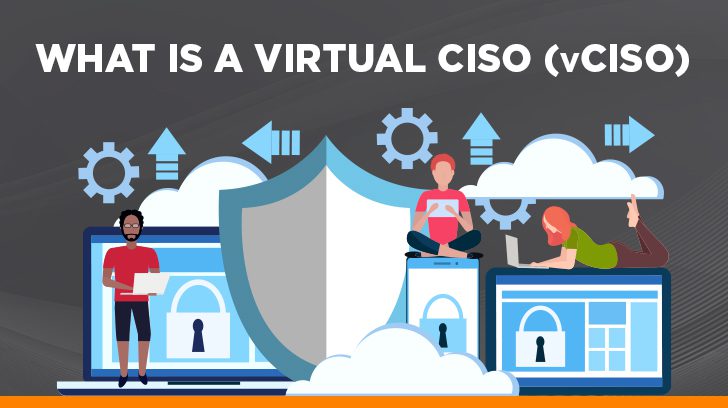
What Is a Virtual CISO?
A vCISO is a senior security practitioner who provides the same strategic leadership as a full-time Chief Information Security Officer but operates as an outsourced, fractional advisor. A CISO is generally a senior-level executive who is “responsible for establishing and maintaining the enterprise vision, strategy, and program to ensure information assets and technologies are adequately protected.” While a full-time CISO is an internal employee dedicated to a single organization, a vCISO is a high-level consultant, often backed by an entire firm of specialists, who manages your security roadmap on a part-time or retainer basis.
To understand the practical differences, it helps to look at what you are “trading off” when choosing between a traditional hire and a fractional model.
CISO vs. vCISO: Comparison at a Glance
| Feature | Full-Time CISO | Virtual CISO (vCISO) |
|---|---|---|
| Employment Type | W-2 Internal Executive | 1099 Outsourced Partner / Firm |
| Total Cost (2026) | $350k – $600k+ (Salary, Bonus, Equity) | $60k – $150k (Avg. Annual Retainer) |
| Availability | 40+ hours/week; On-site immersion | Fractional (e.g., 5–10 hours/week) |
| Org. Integration | Deep; manages internal teams & culture | Strategic; focuses on GRC, audits, and ROI |
| Risk Ownership | Direct personal & professional liability | Advisory liability; shared with the Board |
| Best For | Global enterprises & high-complexity tech | SMBs, Mid-market, & Audit Readiness |
Navigating the Trade-offs
In 2026, the primary trade-off is immersion versus efficiency. A full-time CISO “owns the castle”—they are there for every daily stand-up, every internal cultural shift, and every minor IT hurdle. This depth is essential for massive corporations, but for many organizations, it results in “over-hiring” for tasks that don’t require 40 hours of executive-level attention.
A vCISO, by contrast, brings an “outside-in” perspective honed by working across multiple industries and threat landscapes. They provide the heavyweight strategy you need for SOC 2 audits, AI governance, and board reporting, without the $500,000 price tag. While they may not be in your office every Tuesday morning, they provide the defensible leadership and specialized expertise that smaller internal teams often lack.

Virtual CISO Services & Responsibilities
Like a standard CISO, the vCISO services and offerings are very similar. However, what a vCISO will be responsible for will vary and depend on the specific needs of the organization. Today, these are some of the roles a vCISO will play in the organizations they serve.
AI Governance & “Shadow AI” Management
In 2026, the proliferation of AI agents has created a new frontier for risk. Research from early this year indicates that “Shadow AI” (the use of unsanctioned AI tools by employees) increased by 29% in 2025 alone. A vCISO is now essential for establishing an AI Governance Framework that doesn’t just block these tools but enables the business to use them safely. They move the organization beyond “AI theater” by implementing standardized data pipelines and zero-trust architectures that validate every AI-driven action is secure, auditable, and aligned with corporate policy.
Beyond mere policy, the 2026 vCISO manages the technical integrity of these systems. With 92% of security leaders expressing concern over the security implications of autonomous agents, the vCISO’s role includes monitoring for AI data poisoning and ensuring the “explainability” of automated decisions. By acting as the bridge between innovation and safety, they maintain that the company’s push for AI-driven efficiency doesn’t inadvertently lead to catastrophic data leaks or non-compliance with new global AI standards.
Shifting from Prevention to “Continuous Resilience”
The “secure perimeter” mindset of 2019 has been replaced by the “Downtime Era.” Recent 2026 data shows that endpoint security tools now fail to protect devices nearly 21% of the time, leaving organizations vulnerable for an average of 76 days per year. Because breaches are now viewed as inevitable, the vCISO’s primary value has shifted from “preventing the hack” to “mastering the recovery.” They focus on Cyber Resilience as a measurable KPI, ensuring the business can maintain a “Minimum Viable State” even while under an active automated ransomware attack.
Strategically, this means the vCISO oversees the convergence of data protection and security. In 2026, recovery is no longer an IT “backup” task; it is a core security capability. With the average cost of a data breach hitting $4.88 million this year, a vCISO works to reduce Recovery Time Objectives (RTO). They lead regular “tabletop exercises” that simulate modern threats like deepfake-led social engineering, ensuring the executive team is prepared to make high-pressure decisions that minimize $400 billion in global annual downtime losses.
Navigating Personal Liability & Regulatory Pressure
The regulatory landscape of 2026 is no longer a “suggestion”—it is a legal minefield for executives. With the full enforcement of NIS2 in Europe and the SEC’s tightened disclosure rules in the US, boards are being held personally accountable for cybersecurity failures. A vCISO provides the “defensible evidence” required by these regulators. They translate complex technical risks into business narratives, ensuring that the board has the “expert oversight” necessary to satisfy their fiduciary duties and avoid personal litigation under frameworks like the False Claims Act.
Furthermore, the “compliance crunch” of 2026 has made manual, annual audits obsolete. Modern vCISOs implement Continuous Compliance tools that provide real-time reporting against standards like ISO 27001 or CMMC 2.0. This is critical because 66% of organizations now report they find it difficult to manage these overlapping global regulations in-house. The vCISO acts as a regulatory navigator, ensuring that as new laws emerge, such as the UK’s Data Use and Access Act, the organization remains both compliant and competitive.
The “Human-in-the-Loop” for Automated Defense
While 2026 security is dominated by AI-powered “Agentic” defense systems that can patch and remediate at machine speed, the vCISO provides the critical human judgment that automation lacks. As Sophos experts noted this year, organizations are beginning to feel the “hidden cost of speed,” namely, burnout and automation complacency. The vCISO’s job is to validate that while AI handles the high-volume triage, a human expert remains “in the loop” to oversee high-impact decisions, such as shutting down a production server or reporting a breach to a regulator.
This hybrid approach is the only way to combat AI-assisted cybercrime, where attackers use “prompt injection” and “deepfake audio” to bypass traditional filters. The vCISO designs the “Self-Improving Defense” workflows that allow AI to learn from human feedback loops. They move the security team from routine alert monitoring to strategic threat hunting. In 2026, a vCISO is the architect who facilitates that automation augments human analysts rather than replacing them, maintaining the “foundational knowledge and judgment” required when an incident becomes ambiguous or high-stakes.
Generally, some of a vCISO’s responsibilities will include, but are not limited to, the following:
- Providing the vision, strategy, direction, and implementation of the information security and compliance governance program
- Convey security goals to the organization’s board of directors
- Determining the proper security framework(s) with which the company must comply
- Understanding industry trends and leading the team in architecting security solutions
- Help define security budgets and the most appropriate and cost-effective security solutions
- Providing guidance and support in achieving compliance requirements that the company may have
- Managing the Information Security team
- Defining, planning, writing, reviewing, and approving policies, procedures, standards, and processes
- Supporting or leading the Incident Response team
- Defining the acceptable level of risk and managing the organization’s risk
- Review current internal security controls
- Guide the annual security planning and training
How vCISO Engagements Are Typically Structured
Most 2026 vCISO engagements are built on a subscription-based retainer model, providing the most consistent value for growing organizations. This “fractional” approach typically guarantees a set number of hours or days per month, ranging from a few hours of high-level advisory for startups to 40+ hours for mid-sized firms. These retainers usually cover ongoing duties such as roadmap oversight, board reporting, and vendor risk management. By 2026, the mid-market “sweet spot” for these retainers typically falls between $5,000 and $12,000 per month, a cost that often includes access to a broader “pod” of specialists (like GRC analysts or cloud architects) who support the lead vCISO in executing the security program.
For organizations with a specific, time-bound goal, project-based engagements offer a fixed-fee alternative with clearly defined deliverables. In 2026, these are frequently used for “Accelerators” such as SOC 2 readiness, AI Governance implementation, or NIS2 compliance audits. While project-based fees (often ranging from $15,000 to $50,000+) provide budget certainty for a single milestone, many organizations eventually transition into a retainer to ensure the new security controls are actually maintained. Finally, for very small firms or those with highly unpredictable needs, hourly advisory remains an option; typically at rates of $250–$450 per hour, though this lacks the proactive, “long-term partner” benefit that characterizes the most successful 2026 security programs.

Benefits of a Virtual CISO
Hiring a virtual CISO has many advantages, the most common being cost-effectiveness. Listed below are five high-level benefits:
- Cost-Effective: Finding a qualified CISO to bring into your organization can be expensive; salaries are usually fairly high, as well as an associated benefits package. For many organizations, the need for a full-time CISO may be cost-prohibitive (hiring, benefits, compensation, etc.). Hiring a virtual CISO can make fiscal sense, as you only pay for the time they are working with your organization.
- Adaptive: As organizations grow, change is pretty much guaranteed. Some people are great at startups and others are great at established organizations; many times, one person is not good at both. Consider bringing in a virtual CISO who has the expertise with your tools, marketplace, and organization style. As the organization changes, so can the CISO. Virtual CISOs can also be put on retainer, so they are only used when they are needed.
- Expertise: Virtual CISOs (should) come with a wealth of knowledge. They have a lot of experience with business and security. Having an established track record and expertise with the tool set and marketplace experience allows them to hit the ground running the moment they are signed up.
- Independent: This can be a double-edged sword (you will see I comment on something similar to this below in the disadvantages). Having a virtual CISO that is independent means they are free of politics and conflicting agendas.
- Established Relations and Connections: Many vCISOs have a built-in network and have many connections with vendors and industry professionals. Being able to leverage this network can make growth more streamlined and cost-effective.

Disadvantages of a Virtual CISO
While bringing in a virtual CISO can be very helpful, it is also good to understand the downsides. Below are four disadvantages we’ve seen organizations struggle with when it comes to hiring a vCISO, and in some cases, the deciding factor in choosing a direct hire instead.
- Timeliness of Responses: Since the virtual CISO is not just supporting your organization but supporting many, it can be difficult sometimes to get urgent questions answered in a timely manner. To overcome this, it is recommended to discuss or document an SLA with the candidate prior to bringing them on board. If it is known upfront that you require a response in four hours, then it is easier to manage expectations.
- Lack of Loyalty: Sure, the vCISO technically works for you, but they are not invested heavily in your organization. They do not interact with the staff on a daily basis, they do not know everyone by name, nor do they live and breathe the organization as many internal employees do.
- Lack of Risk Ownership: Look very carefully at the contract and discuss risk ownership openly and candidly prior to hiring a firm or individual. Make sure that they accept some of the organizational risk, as they will, in many cases, be managing it. If your organization gets breached because of a mistake or poor strategy from the virtual CISO, make sure that they don’t just walk away unscathed.
- Expensive in Your Time of Need: Having a vCISO can be very cost-effective, especially if you only need them periodically throughout the year or during compliance audits. But if the organization grows rapidly or experiences a major breach, the hours the virtual CISO starts putting in can be really high, and in turn, may end up costing more than if you just hired a CISO directly.
The Cost of a Virtual CISO: Scaling Expertise, Not Just Savings
The 2019 value proposition was focused on saving money compared to a full-time hire. While still true, the 2026 narrative focuses on Access to Elite Capability. With top-tier CISO compensation now reaching between $300,000 and $600,000, mid-market organizations are effectively priced out of the talent market. A vCISO model allows these firms to “rent” that $500k-level expertise for a fraction of the cost (typically $5,000 to $15,000 per month), ensuring they have the same caliber of leadership as a Fortune 500 company without the prohibitive executive overhead.

Where to Find a Virtual CISO: Key Hiring Considerations
Many security consulting companies provide virtual CISO services, as you can tell when you Google “virtual CISO services,” but it is usually recommended that you ask around to see if your colleagues or peers can recommend one service provider over another. Also, before you begin your search, you need to define what your expectations are and what you actually need. Make sure you also identify how much support you expect and what budget you have available.
For many small and mid-sized organizations, the need for a CISO is driven by regulatory compliance. If you have a client who is asking for a specific report, for example, a SOC 1 report, a SOC 2 report, a HITRUST assessment, or the newly enforced 2026 AI governance audits, it is recommended that you reach out to an external IT audit firm for guidance. We can help you determine if the report is needed and define what it will take to get your organization ready for an assessment. This process often includes identifying whether a virtual CISO is necessary to bridge the gap between your current technical state and the “audit-ready” state required by modern regulators.
Practical Guidance: Evaluating Your vCISO
When vetting a vCISO in 2026, technical certifications like CISSP, CISM, or the specialized CvCISO (Certified virtual CISO) are the baseline, but the most critical asset is prior executive experience. Look for a candidate who has previously held a CISO or high-level Director role in an organization of your size and industry; a vCISO who only knows “Big Tech” may struggle with the resource constraints of a mid-sized firm. During interviews, prioritize communication style over technical jargon; your vCISO must be able to translate “zero-day vulnerabilities” into “business impact” for your Board of Directors. Furthermore, clarify availability expectations upfront: will they be available for a 4:00 PM emergency board meeting, or are they strictly limited to scheduled “fractional” hours?
Red Flags to Watch For
Before signing an engagement, be wary of “vCISO services” that are actually just upsells for a specific software tool. A true vCISO should provide independent, vendor-neutral advice; if their primary solution to every problem is a product they also happen to sell, they are a salesperson, not a strategic leader. Other red flags include a “template-only” approach (where policies aren’t tailored to your specific AI or cloud usage) and poor responsiveness during the scoping phase. If a provider is slow to respond when they are trying to win your business, they are unlikely to be there when you are facing a critical security incident. Always ask for a specific scope document that outlines exactly who owns the “remediation” of found gaps; you don’t want to hire a leader only to find out they expect your already-overstretched IT team to do all the heavy lifting.
Bringing It All Together: Is a vCISO Right for Your Organization?
As your organization scales in 2026, your security commitments and compliance overhead expand exponentially. A virtual CISO (vCISO) acts as your strategic anchor, navigating the complexities of AI governance, ransomware resilience, and a hyper-volatile regulatory landscape. Beyond simply saving you the headache of tracking emerging threats, a vCISO provides the high-level expertise required to secure your AI-augmented workforce and protect your executive board from increasing personal liability.
Furthermore, having a vCISO transforms compliance from a reactive scramble into a streamlined, defensible business asset. In 2026, their leadership is often a prerequisite for passing rigorous examinations like SOC 2, HIPAA, and FedRAMP, as well as meeting the strict “qualified leadership” mandates now required to secure modern cyber insurance policies. If you’re weighing whether a vCISO is the right fit for your organization, contact the team at Linford & Company to discuss our audit services and how we can assist with your specific needs.
This article was originally published on 11/27/2019 and was updated on 4/1/2026.