CMMC & NIST
NIST SP 800-171 Assessments: What to Expect During the CMMC Pause
CMMC Phase 2 is paused, but NIST SP 800-171 still applies. Learn the three ways 800-171 gets assessed and what an independent assessment covers.
If your company handles Controlled Unclassified Information (CUI) under a Department of Defense (DoD) contract, NIST SP 800-171 is the standard your security program is measured against. DFARS 252.204-7012 has required contractors to implement it since the end of 2017. CMMC was built to verify that work through third-party certification, but in July 2026 the DoD paused Phase 2 of the CMMC rollout, which would have required Level 2 certification from an authorized C3PAO in many new contracts. As of this writing no restart date has been announced.
That pause does not take NIST SP 800-171 off the table. The DFARS clauses that require it are still in force, primes are still asking their subcontractors for evidence, and your Supplier Performance Risk System (SPRS) score is still the number contracting officers see. This post explains what a NIST SP 800-171 assessment is, the different ways one gets performed and what to expect from an independent assessment.
What Is NIST SP 800-171?
NIST Special Publication 800-171, Protecting Controlled Unclassified Information in Nonfederal Systems and Organizations, sets out the security requirements a contractor must meet when CUI is stored, processed or transmitted on its systems. DoD contracts reference Revision 2, which contains 110 requirements organized into 14 families, including access control, audit and accountability, configuration management, incident response and system and communications protection.
NIST published Revision 3 in May 2024, but the DoD issued a class deviation that keeps Revision 2 as the version contractors must meet. If you are building or assessing a program for DoD work, Revision 2 is still the right baseline.
A companion publication, NIST SP 800-171A, breaks each requirement into assessment objectives. A single requirement can have several objectives, and every objective has to be met for the requirement to be met. That is the level of detail an assessment works at.
Three Ways NIST SP 800-171 Gets Assessed
Contractors often use "800-171 assessment" to mean different things. There are three common forms and they produce different results.
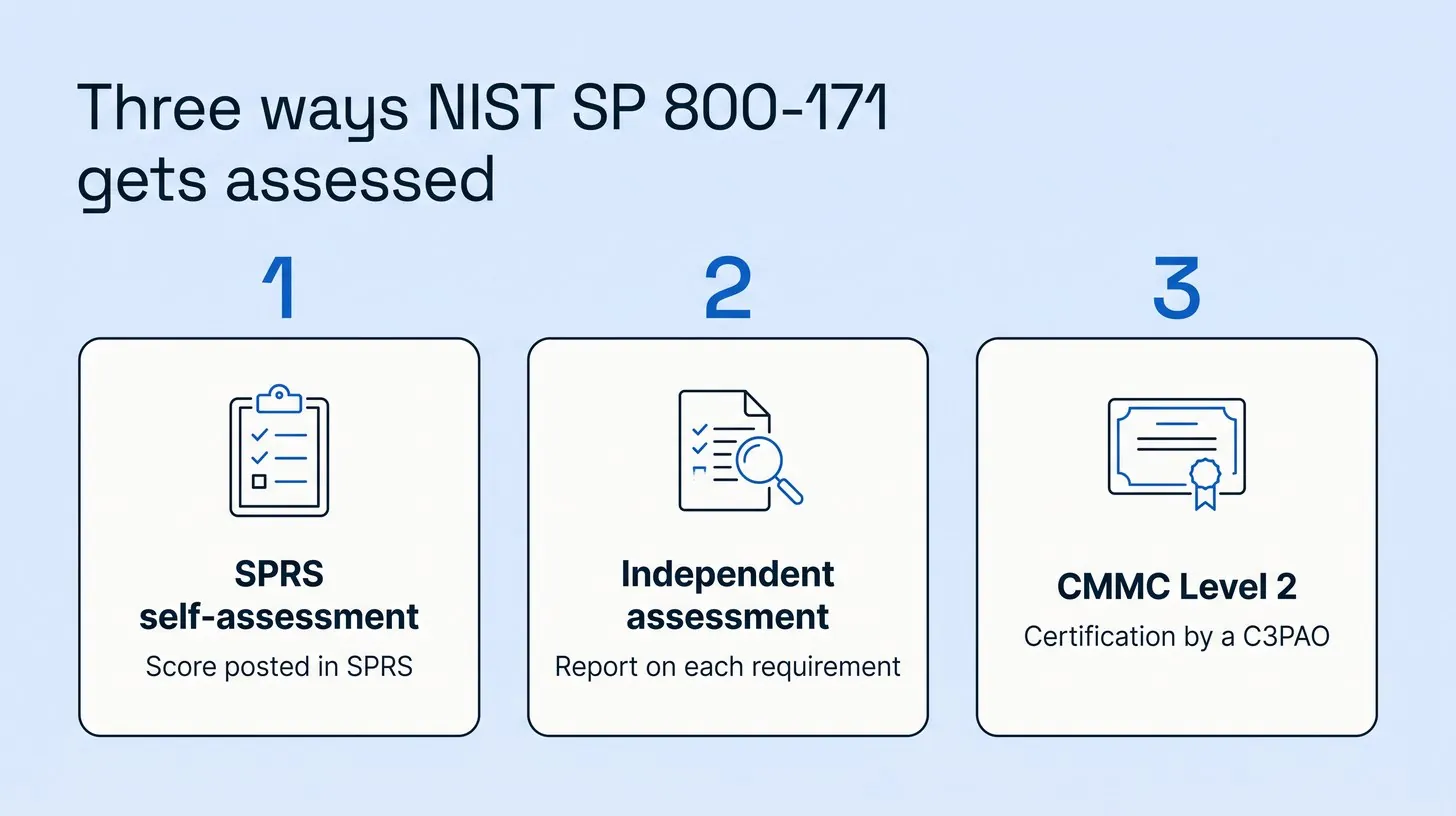
SPRS Basic self-assessment. Under DFARS 252.204-7019 and 252.204-7020, contractors subject to 7012 must post a current NIST SP 800-171 assessment score in SPRS. The Basic assessment is a self-assessment using the DoD Assessment Methodology. You start at 110 and subtract a weighted value for each requirement not met, so scores range from negative 203 to 110. The score must be no more than three years old when a contract is awarded.
Independent assessment. An outside assessor tests your environment against the 800-171A objectives and reports on each requirement. Contractors use an independent assessment to support the score they post in SPRS, to answer a prime's request for evidence or to find out where they stand before a CMMC Level 2 certification assessment.
CMMC Level 2 certification assessment. An authorized CMMC Third-Party Assessment Organization (C3PAO) assesses the same 110 requirements under the CMMC program rules. A passing result produces a CMMC Level 2 certification for the assessed environment. C3PAO assessments are still being performed during the Phase 2 pause, and certifications already issued keep their value.
What an Independent Assessment Covers
Every assessment starts with scope. CUI lives in specific systems, and the assessment boundary should be drawn around the systems, people and facilities that store, process or transmit it, plus the security tools that protect them. A clearly drawn boundary keeps the assessment focused and is often the single biggest factor in how much testing is required.
From there the assessor works through your System Security Plan (SSP), which should describe how each requirement is implemented in your environment. For each assessment objective, the assessor uses the three methods defined in 800-171A:
- Examine: review policies, procedures, configurations, logs and other records.
- Interview: talk with the people who operate and oversee the controls.
- Test: observe the control working, such as attempting access with an account that should be denied or confirming that multifactor authentication is enforced.
Each objective is concluded as met or not met, and those conclusions roll up to each requirement.
Point-in-Time Testing and Retesting
A NIST SP 800-171 assessment is a point-in-time test. That is different from a SOC 2 Type 2, which tests whether controls operated over a period. In an 800-171 assessment, each requirement is tested as of the date the assessor looks at it.
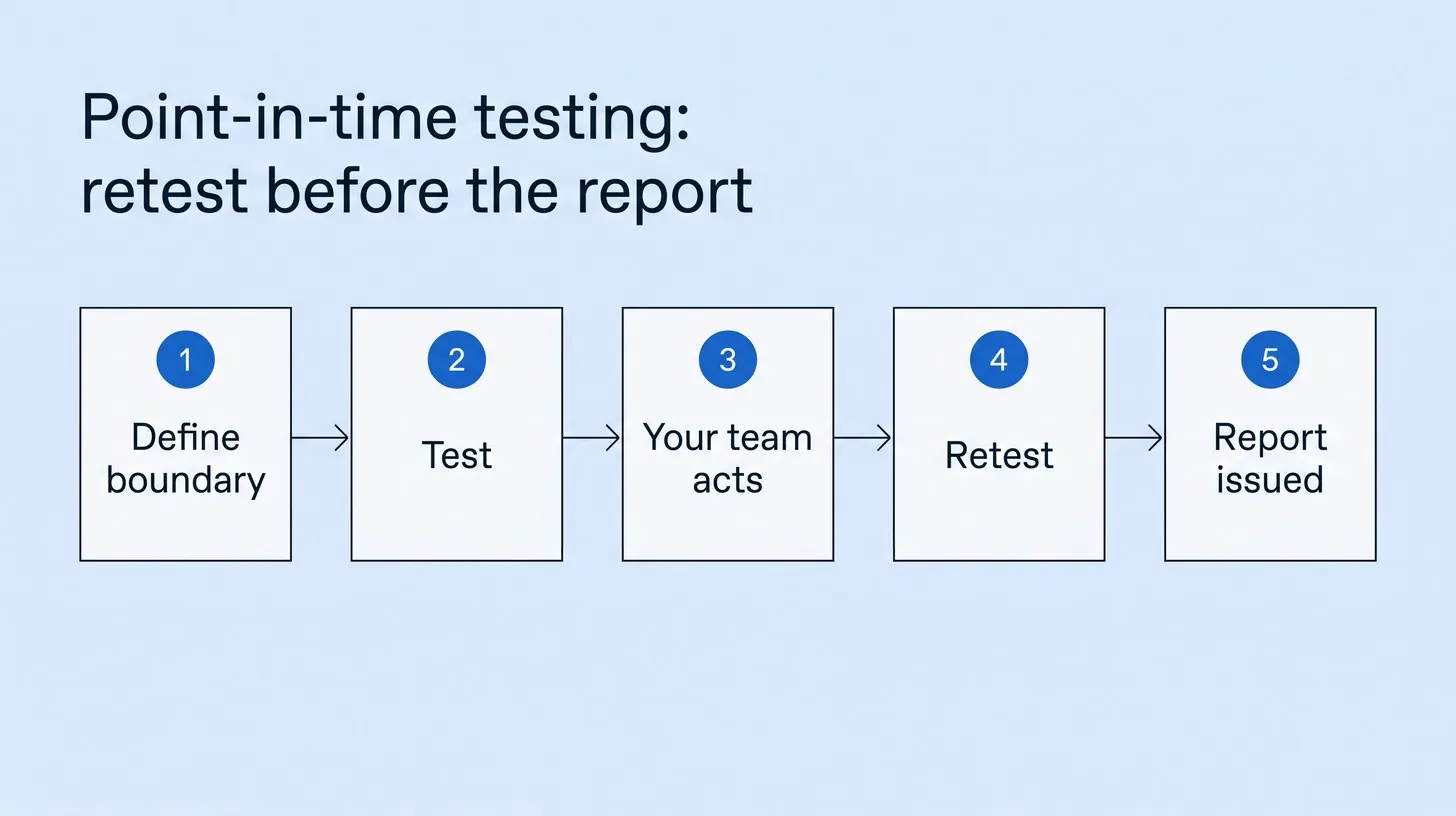
If a requirement is not met when it is tested, your team is responsible for putting it in place. The assessor can then test it again before the report is issued. Requirements that are still not met when the report is issued appear in the report. A Plan of Action and Milestones (POA&M) documents how and when your team intends to close those items, and only certain requirements are eligible for a POA&M under the CMMC rules.
It is important to remember that the assessor's role is to test and report. Designing or implementing controls is your team's responsibility, which is what keeps the assessment independent.
What an Assessment Is Not
An independent NIST SP 800-171 assessment is not a certification. Only a CMMC Level 2 assessment performed by an authorized C3PAO results in a CMMC certification. An independent assessment also does not replace your obligation to post a score in SPRS. Your company remains responsible for the score it submits and for keeping it current.
It is also not a guarantee that a future C3PAO assessment will reach the same conclusions. Environments change, and a requirement that is met today has to still be met on the day it is tested again.
What to Have Ready
An assessment goes most smoothly when the following are in place before testing begins:
- A current SSP that addresses all 110 requirements and matches how your environment actually works
- A network diagram and asset inventory that show where CUI lives and how it moves
- A list of any external service providers and cloud services in scope along with the security documentation they provide
- Your most recent SPRS score and any open POA&M items
- Policies and procedures for each of the 14 families
- Named owners for each control area who are available for interviews
Summary
The CMMC Phase 2 pause changed when third-party certification will be required, not whether NIST SP 800-171 applies. DFARS 252.204-7012, 7019 and 7020 remain in force, SPRS scores still matter in contract awards and primes still want evidence from their supply chain. An independent assessment tests each requirement against the 800-171A objectives as of a point in time and gives you a clear, documented view of which requirements are met. Your team puts any unmet requirements in place and the assessor can retest them before the report is issued.
Linford & Company LLP is an authorized C3PAO and performs NIST SP 800-171 assessments and CMMC Level 2 certification assessments. If you have questions about which type of assessment fits your contracts, contact us.
Related services
CMMC Assessments
CMMC Level 2 certification assessments from an authorized C3PAO.
Related articles
CMMC & NIST
What Is a GSA Nonfederal CUI Assessment? What Contractors Need to Know Before It’s Too Late
Mark Larson · September 2, 2026
CMMC & NIST
A Practical CMMC Compliance Guide for the Defense Industrial Base
Mark Larson · March 11, 2026
CMMC & NIST
NIST SP 800-61 Revision 3: Complete Guide to the New Incident Response Framework
Mark Larson · August 13, 2025